
The Galvanizing Process
We are constantly aiming to improve our service and this information is aimed at providing customers with an insight to our Galvanizing process.
Hot-dip galvanizing is the process of coating steel fabrications with zinc to prevent corrosion.
During this process the fabricated steel is immersed in a bath of molten zinc at a temperature of around 450°C (840°F). The zinc chemically reacts with the base metal to form a protective coating which can remain rust free for a lifetime.
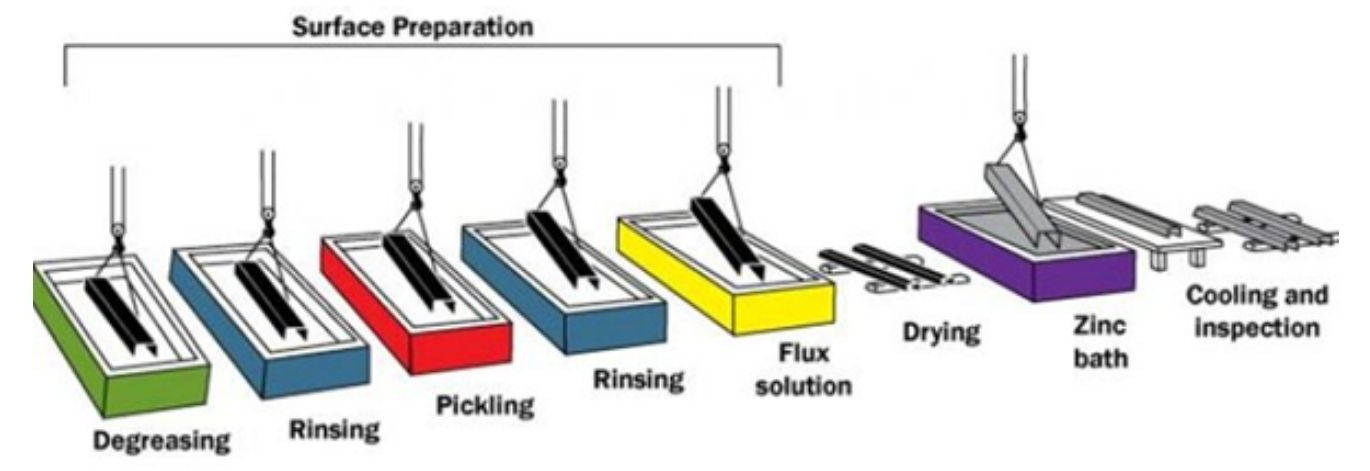
As can be seen from the picture above, galvanizing is a dip process that has many stages. The material must be able to be cleaned through various chemical pre-treatment tanks. For this reason, hollow items must have sufficiently sized holes in the correct place to allow immersion to happen freely.
In addition, all material must be free of paint, sticker residue or any other surface contaminants that prevent the chemicals cleaning the steel and ultimately the zinc bonding with the steel. Clean steel as well as suitable venting and drainage holes are both crucial to the galvanizing process and ultimately the finish of the product.
Although galvanizing is primarily an industrial coating for corrosion protection, our goal is to give our customers the best surface finish achievable. Material presented for galvanizing that has been suitably designed and has large practical vent and drain holes, while being free from paint, stickers or other residues, will achieve the best surface finish.
As galvanizing is a dip process, all material must be able to fit in the tanks. Therefore, the maximum width of material for our tanks at Highland are as follows:
- Cumbernauld = 1.15m max
- Elgin = 1.05m max
Should you wish for any further information please do not hesitate to contact one of our experts.