
Why are overlapping surfaces a problem for galvanizers and how to solve this?
Overlapping surfaces are potentially dangerous as air trapped between surfaces may be converted to superheated steam in the galvanizing bath and can lead to an explosion.
For overlapping surfaces which are 100mm x 100mm or larger and sealed by continuous welding, holes should be drilled as indicated below. This precaution is necessary in order to avoid explosions in the hot dip galvanizing operation and to protect operators.
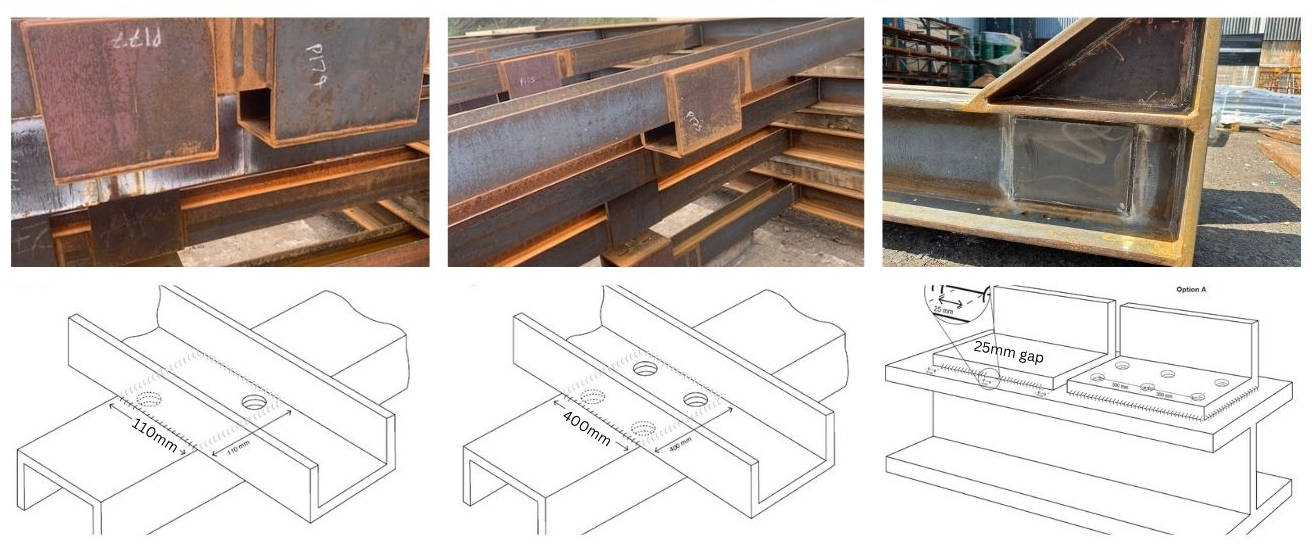
The number and size of holes required to vent an overlapping surface is provided by ISO 14713-2 and takes into account the area of overlap, this is highlighted in the table below.
Ideally holes should be through both sections. An alternative is to use intermittent welds. It should be noted that overlapping surfaces like this can result in pretreatment solutions becoming trapped between the surfaces resulting in potential seepage staining.
| Area of Overlap ‘a’ | Recommended Action |
|---|---|
| a ≤ 100 cm² | Circumferential tight weld. Material should be dry for welding and overlapping parts should be smooth and assembled without gaps. |
| 100 < a ≤ 1000 cm² | In diagonally opposite corners, either: 2 × 12 mm holes at corners or 2 × 25 mm intermittent welds at corners. |
| 1000 < a ≤ 2500 cm² | Either: 4 × 12 mm holes at corners or 4 × 25 mm intermittent welds at corners. |
| a > 2500 cm² | In diagonally opposite positions, either: ≥12 mm holes at corners and circumferentially at least every 300 mm from the corners, or ≥25 mm intermittent welds at corners and circumferentially at least every 300 mm from the corners. |
Note 1: An overlapping area of 100 cm² means 10 cm × 10 cm or 20 cm × 5 cm, etc.
Note 2: Area of overlap ‘a’ represents the areas shown in figures 7a, 7b and 8.
Please note, diagrams are not to scale.
Should you wish for any further information please do not hesitate to contact one of our experts.